A candid look at what a US project lead plus an offshore engineering team actually buys you.
There is a moment, usually somewhere between the proposal and the signature, when a quiet worry surfaces. You have heard the word "offshore," and a story starts to write itself in your head: the work will drift somewhere far away, quality will slip, and by the time anyone notices, you will be the last to know. That worry deserves a straight answer rather than a reassuring smile, so here is one, in writing, before the next call.
The research on high performance keeps pointing to an unglamorous truth: what separates strong outcomes from weak ones is rarely a single burst of brilliance. It is the steady accumulation of effort, applied consistently, over time.1 The interesting question, then, is not whether talent lives in one zip code. It is whether a team is built to sustain focused, deliberate work, day after day. A blended model, structured well, is designed to do exactly that. Consider why.
Follow-the-sun is not a compromise. It is a longer runway.
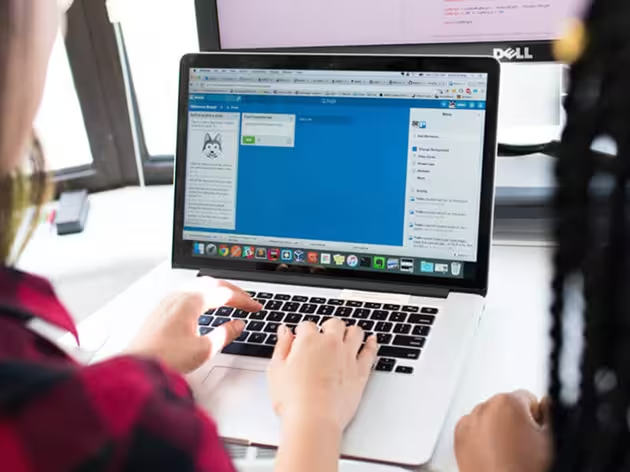
When your project lead sits in the United States and part of your engineering team works many time zones away, the calendar stops behaving like a nine-to-five and starts behaving like a relay. Work handed off at the end of your day is picked up while you sleep, so progress continues on hours that would otherwise be dark. Researchers who study global software teams call this "follow-the-sun," and they are candid about both sides of it: done carelessly, time-zone separation creates delay and confusion, but done deliberately, with clean handoffs and clear ownership, it compresses the calendar in your favor.2
The honest version is this. Follow-the-sun is not free. It rewards teams that write things down, that hand off with discipline, and that treat communication as part of the engineering, not a distraction from it. That is the whole point of pairing it with a senior lead who owns the seams. The velocity is real, and it is earned.
Senior US ownership means the buck stops where you can see it.
Here is the part that should settle the deepest version of the worry. In a well-run blended model, a senior person in your time zone owns your account, your priorities, and your outcomes. That person is the one accountable to you, the one who translates your goals into technical decisions, and the one who catches problems early rather than explaining them late.
The distance you were worried about is precisely what a senior owner is there to close.
Decades of work on professional trust land on the same conclusion: trust is built less by proximity than by reliability, credibility, and a visible focus on your interests rather than the vendor's.3 A named, senior owner is how those qualities become concrete instead of aspirational. You always know who to call, and that person has both the authority and the incentive to make it right.
More senior attention per dollar, stated plainly.
Now the economics, without euphemism. Senior engineering talent in the United States is expensive, and a budget spent entirely on it buys fewer hours than most projects need. A blended model changes the arithmetic. It concentrates your spend where seniority matters most, which is architecture, judgment, and ownership, while a capable distributed team carries the volume of build work.4 The result is not "cheaper and worse." Structured properly, it is more senior attention on your problem per dollar you spend, and more total capacity behind your deadline.
The evidence on distributed knowledge work has grown hard to wave away. Studies of work-from-anywhere organizations, including large, rigorous ones, have found that geographic flexibility can raise output rather than depress it when the operating discipline is in place.5 Distance is not destiny. Process is.
Why you are reading this before the call, and not during it.
There is a reason this is written down. When a concern only comes up live, on a call, it tends to get handled with charm, and charm is not the same as candor. Putting the model in writing, including its trade-offs, does something charm cannot: it demonstrates the very transparency you would want from a partner you are trusting with something that matters.6 Naming the hard parts out loud tends to build more confidence than pretending they do not exist.7
So here are the fair questions to put to any blended team, this one included. Who, by name, owns your account, and are they senior? How exactly does work hand off across time zones, and where is it written down? What happens in the first week when something goes wrong, and how will you hear about it? A team that has built the model on purpose will answer those quickly and specifically. A team that has not will get vague, and vagueness is the real warning sign, far more than a map with two dots on it.
The deepest finding in the study of achievement is also the most reassuring one here. Excellence is not a lightning strike. It is consistency, structure, and effort sustained over time.1 A blended model, with senior ownership near you and steady work continuing while you sleep, is simply one honest way of building a team that can keep showing up. That is worth being confident about, and it is worth asking hard questions about too. Both can be true at once.
References
- Angela Duckworth, Grit: The Power of Passion and Perseverance (New York: Scribner, 2016). Duckworth's central finding is that sustained effort, not raw talent, best predicts high achievement.
- Erran Carmel, J. Alberto Espinosa, and Yael Dubinsky, "'Follow the Sun' Workflow in Global Software Development," Journal of Management Information Systems 27, no. 1 (2010): 17-38. See also Carmel and Espinosa, I'm Working While They're Sleeping: Time Zone Separation Challenges and Solutions (Nedder Stream Press, 2011).
- David H. Maister, Charles H. Green, and Robert M. Galford, The Trusted Advisor (New York: Free Press, 2000). The authors model trust as a function of credibility, reliability, and intimacy, divided by self-orientation.
- Erran Carmel and Paul Tjia, Offshoring Information Technology: Sourcing and Outsourcing to a Global Workforce (Cambridge University Press, 2005), on structuring blended onshore and offshore teams to allocate senior effort where it matters most.
- Prithwiraj Choudhury, Cirrus Foroughi, and Barbara Larson, "Work-from-Anywhere: The Productivity Effects of Geographic Flexibility," Strategic Management Journal 42, no. 4 (2021): 655-683. See also Choudhury, "Our Work-from-Anywhere Future," Harvard Business Review (November-December 2020), hbr.org/2020/11/our-work-from-anywhere-future.
- On candor and transparency as trust-builders in professional relationships, see Frances X. Frei and Anne Morriss, "Begin with Trust," Harvard Business Review (May-June 2020), hbr.org/2020/05/begin-with-trust.
- On transparent storytelling and candor in persuasion, drawing on communication practice taught at Santa Clara University's Leavey School of Business: naming trade-offs openly tends to raise, rather than lower, an audience's trust in the speaker.