

What you'll learn:
- How to build agency partnerships that actually drive consistent deal flow
- How to quickly tell if an agency partnership is worth investing in
- The 3 people you need to know inside every agency
- The process and milestones to go from a basic vendor relationship to a true partnership
- How you can adapt this playbook to your own agency
Why this matters now.
Here's how I think about it: ads cost money, content marketing and outreach take time, and when you stop investing in those channels, pipeline dries up. A well nurtured agency partnership compounds over time. One partner that truly understands what you do and knows how to talk about it can refer dozens of projects for years.
Obviously a partner isn't obligated to send you work. But when their leadership is bought in, their sales team knows how to sell you, and their PM genuinely wants to keep working with you, referrals come naturally.
Especially right now, when so many shops are niching down. The opportunity for collaboration and referrals is greater now than ever before. And most are overlooking it, or just don't have a playbook for it.
My agency, White Rabbit Group, has spent the last several years figuring out partnerships. We are a team of 75+, approaching our tenth year, with over 160 agency partnerships. The vast majority of our growth has come through agency referrals, not paid ads or cold outreach.
We’ve tested and refined this process so that partnerships are repeatable and predictable, while still feeling entirely organic.
Here is how to do it.
The process at a glance.
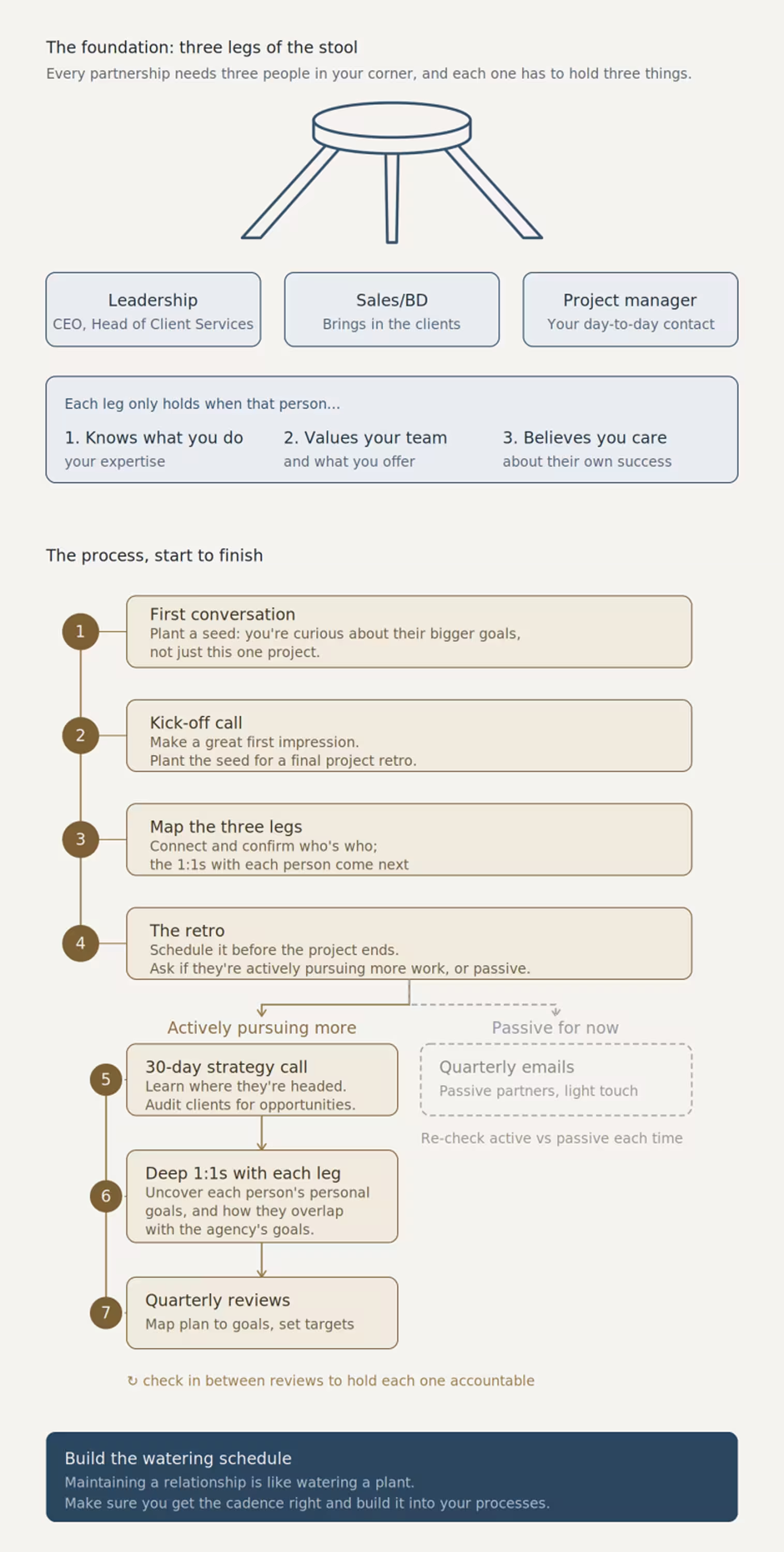
First, identify the right decision makers.
I've come to believe that every agency partnership has three people who need to be in your corner. If any one of them is missing, the relationship has a weak point, and in my experience, that's usually where things eventually break. We call it a stool because if you pull out any one of these relationships, the whole thing tips over.
- Leadership (CEO, COO, Head of Client Services). They need to understand what you actually do and believe in the value of the partnership. Without that buy-in, you're one budget conversation or one new hire away from losing the relationship.
- Sales or Business Development leader. This is whoever is responsible for bringing in new clients. If they can't explain what you do clearly, they won't bring you up. It's about fluency. A salesperson who's never had to describe your services to a prospect is not going to do it with any confidence, which means they're probably not going to do it at all.
- Project Manager. This is the person your team actually works with. If this relationship breaks down, none of the others matter. The PM shapes how you're talked about internally, and the day-to-day experience is what people remember long after the deliverable is forgotten.
Your first potential project.
When a prospective partner brings you a potential project, they usually want two things: a price and a timeline. That's fine, that's where the conversation has to start. But this is also an opportunity to ask about their business goals and what this project means to them at a bigger scale. You don't need to get into the weeds yet. You're just planting a seed: that you care more about them than delivering this one project.
Before kick-off, connect with their team members on LinkedIn and start building a picture of who these folks are. Over the course of the project, confirm who fills each leg of the stool and start building individual relationships with each of them. By the time the work wraps, you should know who you need to have meaningful relationships with.
Plant the seed at kickoff.
During your initial meeting, set the expectation that you will host a retrospective at the end of the project. Emphasize how critical this feedback loop is to your team’s process and let them know upfront that you will proactively reach out to get it on the calendar before the project officially wraps.
The retrospective.
If they're treating it passively for now, they go into a lighter cadence: quarterly email check-ins to stay on their radar without either side over-investing. Not every partner is ready to go all in, and that's fine.
- The first 10-20 minutes are backward looking: what went well, what could have gone better. Keep it honest but not exhaustive. You're not trying to solve every problem on this call, you're making sure nothing's left unaddressed and they feel heard.
- The next 10 minutes are forward looking: "What does success look like for them for the rest of the year? Are you actively looking to bring in more of this type of work or is this more of a passive situation for now?" If they say they're actively pursuing more of the type of work you offer, push on it gently. Something like: "Is that genuinely a top priority for your team right now? We sometimes hear that in these conversations when it isn't really the case yet, and that's completely fine. I just want to understand how serious you are about it so we can actually be useful if you are." The goal isn't to pressure anyone. You're just trying to save both sides from investing in a direction that isn't ready to go anywhere.
- The last ten minutes are next steps, and this is where the process forks. If they're actively pursuing more of this kind of work, book a strategy call within 30 days before the call ends. Let them know: "I'd love to schedule another call to find out what your current strategy is for bringing in more of this kind of work. We've seen what's worked across a lot of our other partners, and I think there are probably ways we can help with that."
Individual 1:1s.
The goal across all three is to show each person that you care about their specific situation, not just the account in general.
- With leadership, you're trying to understand the business at a strategic level: "What does growth look like for you this year, and how does our type of work fit into that? Are there clients in your current roster where you feel like you're leaving opportunity on the table? What would have to be true for you to bring us into a pitch before the project is even won?"
- With sales or BD, you want to understand how they're selling and where the friction is: "When our services come up in a client conversation, how do you typically describe what we do? What objections do you run into when you bring in a partner? What types of projects are you actively going after right now where we might be useful?" With larger sales teams, a lunch & learn can be more effective than individual conversations. You get everyone in the room at once, coach them on how to position what you do, and make sure the whole team is speaking the same language.
- With the PM or day-to-day contact, it's more operational and personal: What made this project harder than it needed to be? How do you prefer to work with outside teams?
The 30-day strategy call.
Position the conversation as a pure win-win. Your goal is to build enough trust that they feel comfortable sharing their existing client roster. Keep the ask simple and low stakes: "Would you be open to having us do a quick audit of your current or previous clients to see if we spot any opportunities?" Make it clear that there are zero strings attached at this stage. You are simply offering your expertise to help them uncover hidden upsell revenue.
Willingness to actively pursue more collaborations and willingness to share their client list are your two signals that this relationship is worth the full investment. If both are there, you know where to start: their existing clients. It's the easiest place to generate new work quickly, and quick wins build trust faster than anything else. Big or small, every additional project is another opportunity for them to experience working with you, and as long as you're doing good work, that trust compounds.
After two or three projects, the relationship is in a different place. That's when you can go deeper on how they're currently pursuing new clients: "Are you running ads to attract this kind of work? Where are new opportunities actually coming from?" That's when you start introducing ideas for how to bring you into their new business conversations as a cross-sell or upsell. But that's a later conversation. Early on, the existing client base is where to focus all of your energy.
- Learn what their current strategy is for growing the side of their business that you can help with
- And start to share what you've seen work across other partnerships. This is where you begin to create a long-term vision together.
Quarterly business reviews.
But the QBR is only part of it. In between reviews, check in individually with each leg of the stool to see how things are progressing. Follow up on what was committed to, remove any obstacles that may have come up, and make yourself available for anything they need help with. The QBR sets the direction. The in-between touchpoints are what actually keep things moving.
- Client audits: Auditing a specific number of existing clients to uncover hidden opportunities.
- Joint pitches: Delivering a set number of collaborative estimates or pitches per quarter.
- Shared Revenue: Hitting a specific, mutual revenue milestone for the year.
- Contract expansion: Increasing the average contract value (ACV)
- Sales enablement: Hosting "lunch and learns" to train their team on how to spot and sell your services.
- Co-marketing: Producing collateral together like co-branded case studies or webinars to generate new inbound leads together.
A few questions to start applying this to your agency.
- Before you think about building new partnerships from scratch, look at who you already know. Who in your existing network serves a complementary niche? Those are the easiest partnerships to formalize because trust is already there.
- Who at each agency fills the 3 legs of the stool? Connect 1 1 and get to know them on a personal level.
- When you've gotten repeat business or referrals in the past, what actually led to it? There are usually patterns.
- Next is to systematize your process. Write down critical touchpoints, put them in your CRM, and build a schedule for staying in contact with the right people at the right time.
-- Adam Weil | Partner at White Rabbit Group